

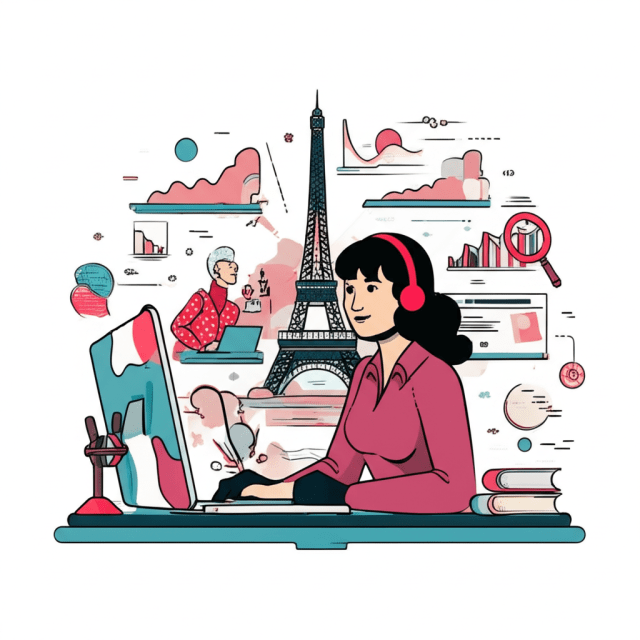
Bonjour! It’s Sophie, your Parisian UX designer (now Belgium based), back again. For a decade, this blog has been my petit coin dedicated to discussing UX in the language of Molière. Today, I come to you with an announcement that might raise an eyebrow or two: on passe à l’anglais! Before you cry “Sacrilège!”, allow me to explain why this isn’t an abandonment, but an evolution, a broadening of horizons, if you will.
The French UX Scene: From “Balbutiements” to Boom!
Do you recall the early days? My original mission was simple: to cultivate fertile ground for UX methods in France. UX was – and in some corners, remains – in its balbutiements here. This blog was a humble attempt to sow seeds of awareness, to spread the gospel of user-centered design, to share the tools and, above all, the passion. But regardez-nous maintenant! Look how far we’ve come!
The French UX community is vibrant and thriving. The job market has exploded – demand is up by a staggering 239%! Universities and bootcamps are churning out talented designers faster than you can say “expérience utilisateur”. We have cool agencies and engaging events like “UX Days” popping up across the Hexagon. C’est magnifique!
Let’s not forget our uniquely French heritage. We have our ergonomistes, those diligent ancestors who toiled in the fields of human factors long before the term “UX designer” crossed the Atlantic. There’s a friendly rivalry, a semantic debate, perhaps, with our American counterparts. However, both ergonomistes and UX designers are striving for the same goal: making experiences fantastique for humans.
Why English? It’s Not Just About Being Chic, C’est Global!
Why English, you ask? Is it merely about being chic? Non, non, et non! It goes much deeper. English is not just a language; it’s the lingua franca, the operating system, if you will, of the global tech and UX world.
Consider this: the programming languages that power our digital world, the key conferences where groundbreaking ideas are born, the major platforms like Stack Overflow and GitHub where developers and designers collaborate – they all speak English! To limit ourselves to French is to voluntarily disconnect from the mainframe.
Think of the sheer volume of knowledge locked away in the English-speaking world! Accessing the latest research, cutting-edge trends, and groundbreaking ideas becomes exponentially easier when we tap into the global pool. No more waiting for translations, no more relying on second-hand accounts. We can drink directly from the source, indulging in an all-you-can-eat buffet of UX wisdom.
And what about networking? Speaking English unlocks superpowers, granting us access to UX rockstars from around the globe. It opens doors to international collaborations, remote work opportunities, and exciting projects beyond the borders of France. By embracing English, I hope to amplify my own professional visibility and establish my personal brand on a global stage.
The Nuances, The Future: French Flair on a Global Stage
Ah, mais! What about the nuances, the subtle shades of meaning that get lost in translation? What about the inherent “controversy” of imposing a single language on a diverse world?
Let’s be clear: it’s not simply about swapping French words for English ones. French design possesses its own unique artistic heritage and cultural flair. We must acknowledge the challenges: French words tend to be longer, which can create headaches in UI design. The level of formality varies significantly between the two languages, and cultural nuances are paramount. I am aware that nearly half of global consumers feel frustrated by English dominance, and I empathize with that sentiment.
However, I believe that French UX has much to offer the global stage. We can infuse our work with our unique cultural perspective, sharing our “French touch” with the world. France is a leader in eco-design and is striving for carbon neutrality – our UX practices reflect this commitment to sustainability. We are at the forefront of integrating cutting-edge technologies like AI, AR, and VR into enterprise solutions. And thanks to GDPR and the European Accessibility Act, we are already champions of ethical, transparent, and accessible design.
My goal, therefore, is not to become “less French,” but to share our unique perspective and contribute our je ne sais quoi to the global UX conversation.
Conclusion: Join Me on This Global Adventure!
My commitment remains unchanged: to share insights, tips, and reflections on experience design. Now, however, we will do so on a grander stage, reaching a wider audience, and fostering a more inclusive dialogue.
Let’s keep the conversation flowing, break down language barriers, and work together to make UX truly universal.
Alors, qu’en pensez-vous? Are you ready to embrace the global UX dialogue with me? Share your thoughts in the comments below!

 UX In France
Respond to Pourquoi je dis Adieu à la langue de Molière (pour l’anglais!)